- Home
- Patient Information
- Care and Comfort
- Advanced Technology
Advanced Technology
When you seek care at our office, you are assured that Dr. Malik, Dr. Dawood, Dr. Szczepanik, and their staff utilize the latest in technology to enhance the quality and fit of your dental care.
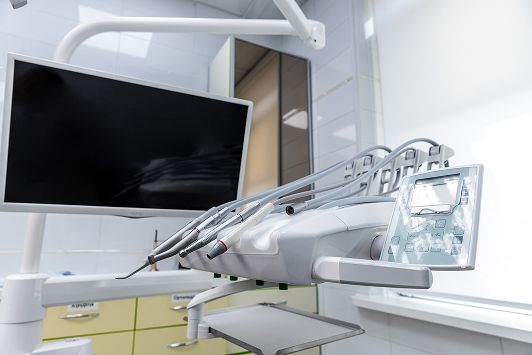
Many dentists use air-driven "handpieces" (the dental term for "drills"). While acceptable for many procedures, these "whiny-sounding" air-powered handpieces all have a degree of non-concentricity; they do not rotate perfectly smoothly.
For the most precise aspects of restorative procedures, we use electric handpieces. This results in extraordinarily precise interfaces between your tooth and your new restoration (dental crown, tooth veneer, or tooth filling). This will bring more comfort to you as well. With a more precise tool, there is less vibration and less noise.
- More precise
- Less vibration
- Less noise
Digital Imaging
Drs. Malik, Dawood or Szczepanik choose carefully when and which radiographs are taken. There are many guidelines that we follow. Radiographs allow us to see everything we cannot see with our own eyes. Radiographs enable us to detect cavities in between your teeth, determine bone level, and analyze the health of your bone. We can also examine the roots and nerves of teeth, diagnose lesions such as cysts or tumors, as well as assess damage when trauma occurs.
Dental radiographs are invaluable aids in diagnosing, treating, and maintaining dental health. Exposure time for dental radiographs is extremely minimal. Drs. Malik, Dawood and Szczepanik utilize Digital Imaging Technologies within the office. With digital imaging, exposure time is about 50 percent less when compared to traditional radiographs. Digital imaging can also help us retrieve valuable diagnostic information. We may be able to see cavities better.
Digital imaging allows us to store patient images, and enables us to quickly and easily transfer them to specialists or insurance companies.
Digital X-Rays:
Digital X-rays offer more precision since we view the image on a computer monitor, instead of holding a 35mm film up to the light. Digital X-rays result in 1/6th the radiation exposure to you.
Intraoral Camera
Many patients, especially younger patients, are very familiar with the latest technology and are comfortable with a high-tech practice. Computers and TV screens are their primary method of information processing.
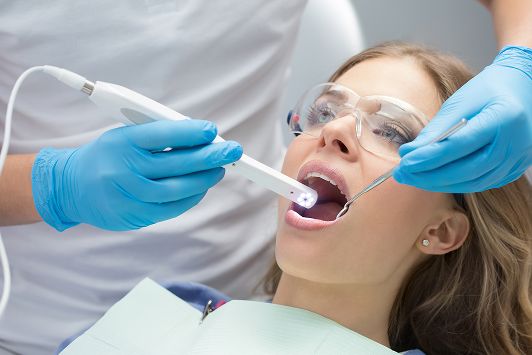
Drs. Malik, Dawood and Szczepanik utilize Intraoral Camera technology that helps enhance your understanding of your diagnosis. An Intraoral Camera is a very small camera – in some cases, just a few millimeters long. An Intraoral Camera allows our practice to view clear, precise images of your mouth, teeth and gums, in order for us to accurately make a diagnosis. With clear, defined, enlarged images, you see details that may be missed by standard mirror examinations. This can mean faster diagnosis with less chair-time for you!
Faster diagnosis with less chair-time for you!
Intraoral cameras also enable our practice to save your images in our office computer to provide a permanent record of treatments. These images can be printed for you, other specialists, and your lab or insurance companies.
3D Scanner
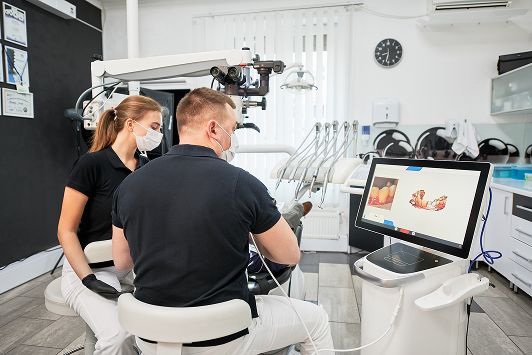
Our practice utilizes state-of-the-art, small volume cone-beam CT (computed tomography) technology that provides highly accurate, 3D radiographic images for diagnosis, treatment planning and treatment. This allows three-dimensional visualization of teeth, bone, sinuses and surrounding structures with minimal radiation to the patient, enabling a level of anatomical accuracy and patient care not possible with 2-D technologies (regular dental x-rays).
More in Patient Information
Not sure where to start? Call our office and a team member will guide you.